
Book Appointment Now

DEXA Scan
Gold-standard, low-radiation 3D screening to measure bone strength, osteoporosis risk, and body composition.
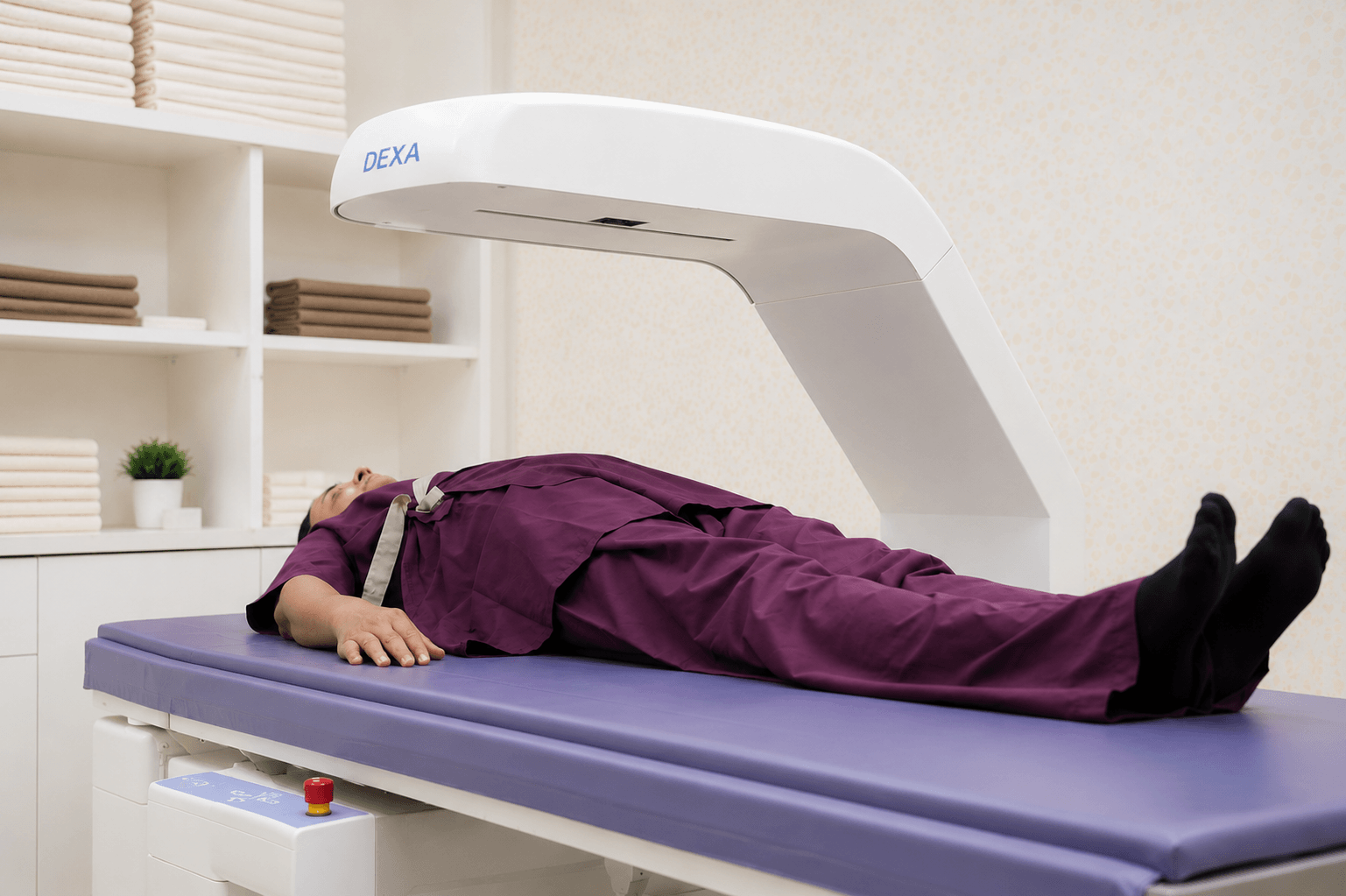
DEXA Scan (Bone Densitometry)
Ultra low-dose X-ray scan that measures bone mineral density to assess osteoporosis risk and bone strength — most often recommended for women post-menopause and adults over 50. It is completely painless, fast, and highly accurate in identifying bone thinning long before a fracture occurs.
Commonly Booked Tests
Ultra-Low Radiation:
Less than 1/10th of a chest X-ray
Less than 1/10th of a chest X-ray
Scan Duration:
10–15 Minutes
10–15 Minutes
Preparation:
Stop calcium supplements 24h prior
Stop calcium supplements 24h prior
Report Delivery:
Within 1 Hours
Within 1 Hours
What to expect
You will lie comfortably fully clothed on a padded DEXA couch.
A low-dose detector arm gently moves overhead without touching you.
You will be asked to hold still for 10–20 seconds while individual regional scans are taken.
A low-dose detector arm gently moves overhead without touching you.
You will be asked to hold still for 10–20 seconds while individual regional scans are taken.
Prep Instructions
Stop calcium supplements or multivitamins at least 24 hours before scan.
Wear comfortable clothing without metal buttons, zippers, snaps, or underwires.
No Fasting Needed: You may eat, drink, and take regular medications normally.
Wear comfortable clothing without metal buttons, zippers, snaps, or underwires.
No Fasting Needed: You may eat, drink, and take regular medications normally.
FAQ’s
Is DEXA radiation harmful?
No. DEXA uses an extremely tiny radiation dose—less than 1/10th of a standard chest X-ray and less than the natural background radiation you receive in a single day outdoors.
What is the difference between a T-Score and a Z-Score on a DEXA report?
A T-Score compares your bone density with that of a healthy 30-year-old adult of your sex (used to diagnose Osteopenia or Osteoporosis). A Z-Score compares your bone density to what is expected for someone of your same age, sex, and weight.
Why must I stop calcium supplements 24 hours before the scan?
Undissolved calcium tablets in your stomach or intestinal tract can block or distort the low-dose X-ray beams, leading to false elevation of your lumbar spine bone density numbers.
Who should get a DEXA Scan? How often should I repeat a DEXA scan?
It’s commonly recommended for women post-menopause, adults over 50, or anyone with risk factors for osteoporosis. Most doctors recommend repeating it every 1–2 years, depending on your initial results and risk factors.