
Book Appointment Now

Digital X-Ray
Ultra-low radiation, high-definition digital radiography for bones, joints, chest, and specialized contrast studies.
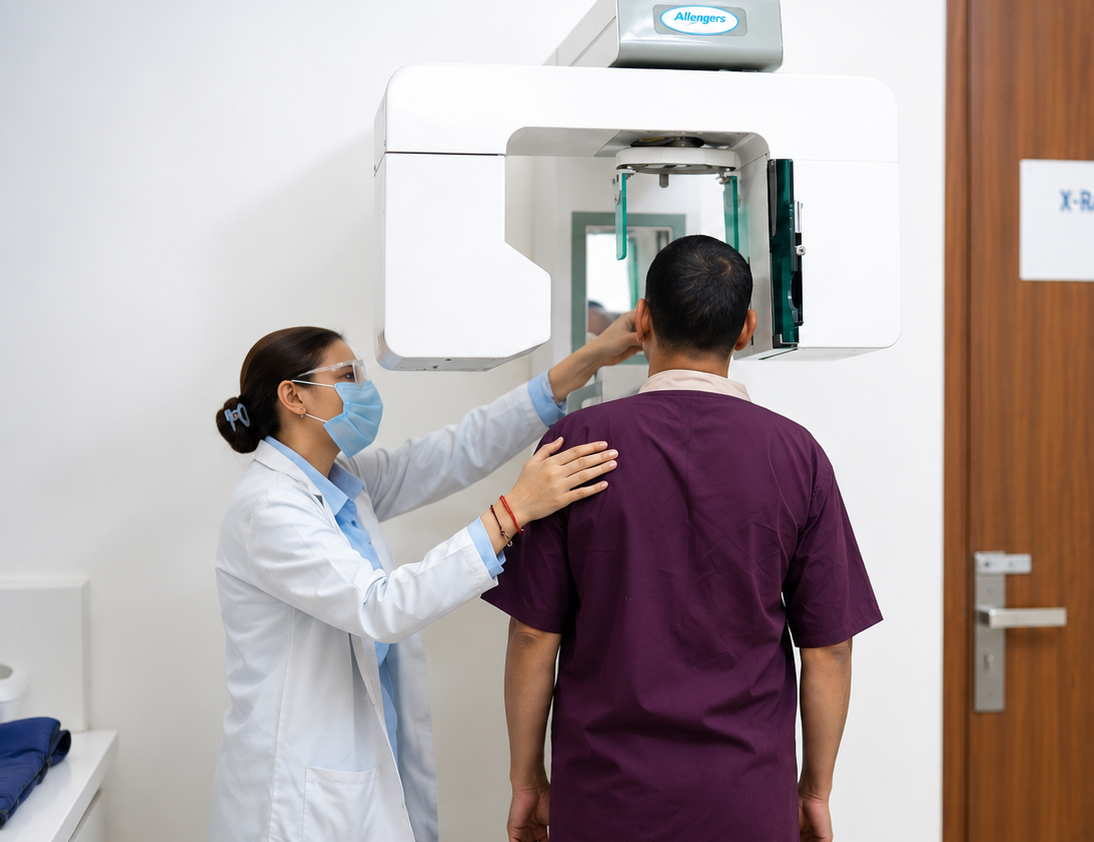
Digital X-Ray Services (CR/DR Systems)
A quick imaging test that uses a small, well-regulated amount of radiation to capture images of bones and certain organs — one of the fastest, most accessible ways to check for fractures, infections and chest conditions.
Unlike traditional film X-rays, modern Digital Radiography uses electronic sensors instead of photographic film. This results in up to 80% lower radiation exposure, immediate image capture within seconds, and razor-sharp digital contrast that allows senior radiologists to detect hairline fractures, joint degradation, lung infections, and bone lesions effortlessly.
Unlike traditional film X-rays, modern Digital Radiography uses electronic sensors instead of photographic film. This results in up to 80% lower radiation exposure, immediate image capture within seconds, and razor-sharp digital contrast that allows senior radiologists to detect hairline fractures, joint degradation, lung infections, and bone lesions effortlessly.
Instant Processing:
Digital Direct Radiography (DR) technology
Digital Direct Radiography (DR) technology
Scan Duration:
5 Minutes
5 Minutes
Fasting:
4–6 Hours Fasting Required
4–6 Hours Fasting Required
Walk-In Available:
No long waiting times
No long waiting times
Commonly Booked Tests
What to expect
You’ll stand or lie in position for a few seconds while the image is captured. The radiographer positions the digital X-ray tube over the targeted region. No injections or contrast involved.
Prep Instructions
No fasting needed. Wear comfortable clothing. Remove metal jewellery or objects from the area being imaged. Inform staff if you are or may be pregnant.
FAQ’s
Is a Digital X-Ray safe? How much radiation am I exposed to?
Yes, modern Digital Radiography (DR) is extremely safe. Digital detectors require up to 80% less radiation than traditional film X-rays. A standard chest X-ray exposes you to about 0.1 mSv of radiation—equivalent to the natural background radiation you absorb from the environment over just 10 days.
What is the difference between CR and DR Digital X-Ray?
Both are digital systems, but DR (Direct Radiography) is the newer, faster technology. DR transfers images directly to the computer screen within 2–3 seconds with higher contrast resolution and lower radiation doses, eliminating the intermediate processing plate used in older CR systems.
Do I need an appointment for a standard X-Ray?
No! Standard bone, joint, and chest X-rays are conducted on a walk-in basis. Specialized contrast studies (like HSG, IVP, or Barium studies) require prior booking to ensure proper preparation.
Can pregnant women get an X-Ray?
As a safety rule, X-rays are generally avoided during pregnancy—especially abdominal, pelvic, or lower back X-rays—unless medically necessary in emergency situations. Always inform our technician if you are pregnant or suspect you might be pregnant. Lead aprons and shielding are strictly used when non-abdominal X-rays (like hand or dental) are essential.