Book Appointment Now

CT Angiography
Advanced 3D non-invasive vascular imaging to detect blockages, aneurysms, and blood flow restrictions in seconds.
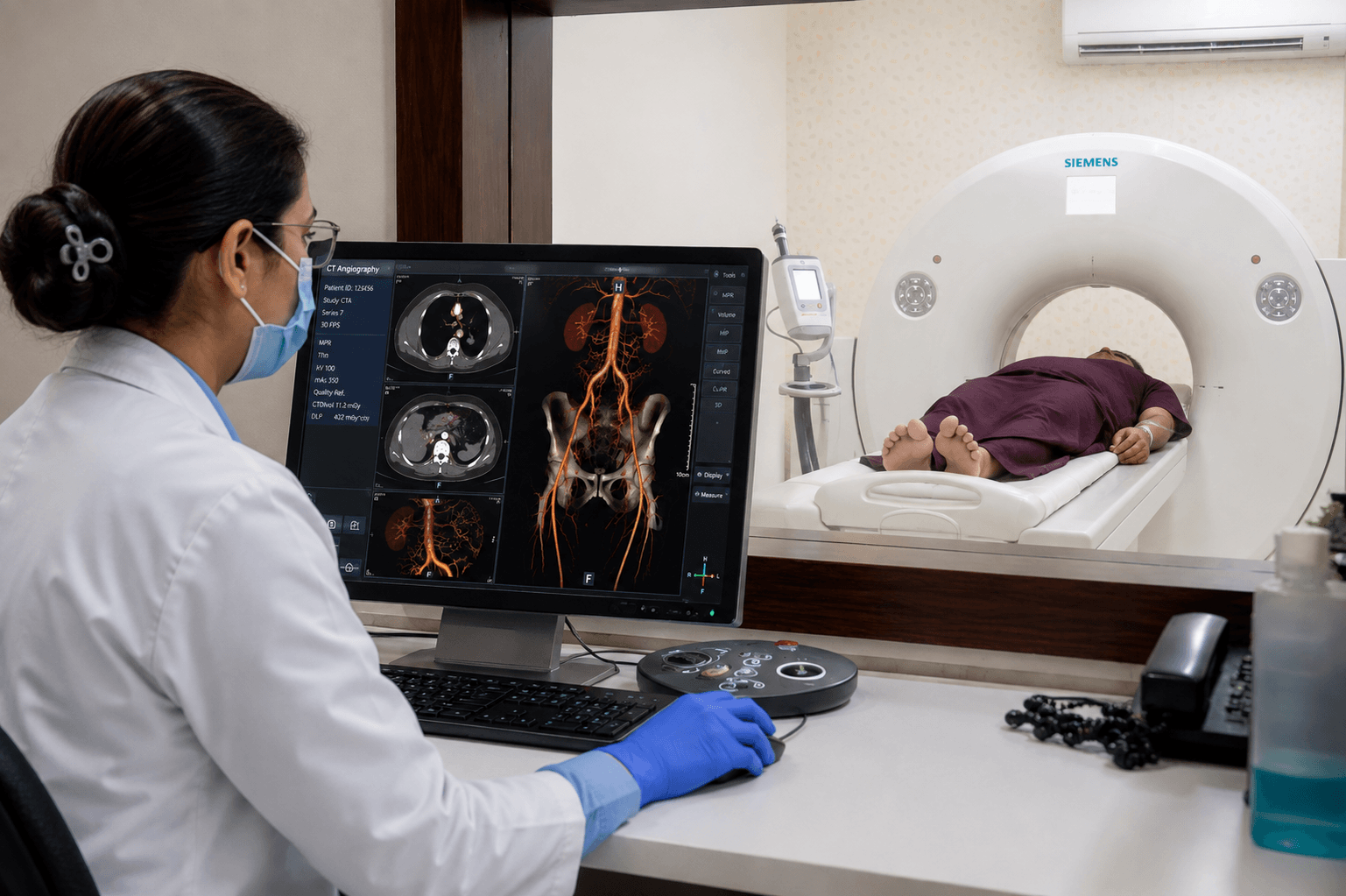
CT Angiography & Venography (CTA Scan)
A specialised, contrast-enhanced imaging scan that maps blood vessels to detect blockages, narrowing or abnormalities — commonly used to evaluate heart, brain, limb circulation and renal vessels
While Angiography focuses on arteries (carrying oxygenated blood from the heart), Venography focuses on veins(returning blood to the heart). Together, these scans allow senior radiologists to view vascular networks with sub-millimeter precision without requiring invasive catheterization.
While Angiography focuses on arteries (carrying oxygenated blood from the heart), Venography focuses on veins(returning blood to the heart). Together, these scans allow senior radiologists to view vascular networks with sub-millimeter precision without requiring invasive catheterization.
Prerequisite:
Recent Serum Creatinine (KFT) Report Required
Recent Serum Creatinine (KFT) Report Required
Scan Duration:
15–30 Minutes
15–30 Minutes
Fasting:
4 Hours Fasting Required
4 Hours Fasting Required
Report Delivery:
Within 1 Hours
Within 1 Hours
Commonly Booked Tests
What to expect
Our nursing team will place a standard IV cannula in your arm for automated contrast injection. You will lie comfortably on the motorized table.
As contrast dye enters your vein, you will feel a brief warm sensation lasting 15 to 30 seconds.
The scan captures thousands of slices in just 5 to 10 seconds during a single breath-hold.
As contrast dye enters your vein, you will feel a brief warm sensation lasting 15 to 30 seconds.
The scan captures thousands of slices in just 5 to 10 seconds during a single breath-hold.
Prep Instructions
Fasting: Fast for 4 hours prior to your scheduled slot (clear drinking water is allowed).
Bring your latest Serum Creatinine (KFT) report (<30 days old).
Medication: Continue regular blood pressure medications. If taking Metformin for diabetes, notify our technician beforehand.
Drink 2 to 3 liters of water over the rest of the day to quickly flush the dye out through your kidneys.
Bring your latest Serum Creatinine (KFT) report (<30 days old).
Medication: Continue regular blood pressure medications. If taking Metformin for diabetes, notify our technician beforehand.
Drink 2 to 3 liters of water over the rest of the day to quickly flush the dye out through your kidneys.
FAQ’s
Is CT Angiography better than traditional invasive Angiography?
Traditional invasive catheter angiography is both diagnostic and therapeutic (it allows doctors to place a stent in the same sitting), but it requires a minor surgical procedure, groin/wrist entry, and hospital admission. CT Angiography is purely diagnostic, fast, completely non-invasive, and carries far lower risk. It is ideal for screening, rule-outs, pre-surgical planning, and routine evaluation without hospital stay.
What is the benefit of doing CT Renal Angiography + CT Urogram together?
This combined test provides a complete diagnostic assessment of your urinary and vascular kidney system in a single appointment. It looks at the Renal Arteries (checking for narrowings that cause high blood pressure) while simultaneously tracking how urine drains through the Kidneys, Ureters, and Bladder (checking for stones, masses, or blockages).
Why is a Serum Creatinine test required before CT Angiography?
CT Angiography relies on iodinated IV contrast dye to make blood vessels visible. Since contrast dye is cleared from the body through the kidneys, checking your Serum Creatinine level verifies that your renal function is healthy enough to clear the dye smoothly without risk.
How long does the CT Angiography scan take?
The contrast dye is very safe for individuals with normal kidney function. During injection, you will experience a transient warm sensation across your body and a slight metallic taste in your mouth, which disappears within 30 seconds. Mild allergic reactions (like skin hives) are rare, and our medical facility is equipped with full emergency management protocols.